
According to OPSWAT's Threat Landscape Report (2025), malware complexity rose 127% in a single year, and 1 in 14 files deemed "safe" by traditional security tools later turned out to be malicious.
The numbers point to a growing detection gap: the difference between malicious activity that can successfully execute inside a system and the ability to recognize it in time.
Two core methodologies can be combined to close this gap.
Static analysis - fast and effective against known threats, but examines files without executing them, missing hidden behaviors.
Dynamic analysis - goes deeper by observing runtime behavior, yet it's slower, more resource-intensive, and can be evaded by malware that detects sandboxes or delays activation.
Even combining both approaches isn't a complete answer, which is what this article explores, along with the additional security layers needed for effective file protection.
Static Analysis: Fast and Scalable, but Limited Visibility
Static analysis is the process of inspecting a file without executing it.
Instead of running the file, it examines file structure, metadata, and contents to identify malicious characteristics.
Common static analysis techniques include:
Hash-based identification using MD5, SHA-1, or SHA-256
Signature-based detection and pattern matching
PE (Portable Executable) header analysis
String extraction and analysis
YARA rule matching
Entropy analysis to identify packed, encrypted, or obfuscated files
Import/export table analysis
Embedded resource and metadata analysis
Reputation-based analysis (file, publisher, certificate, URL reputation)
Key Strengths of Static Analysis
Since the file is never executed, static analysis is extremely fast and resource-efficient, with verdicts returned in seconds. This speed makes it suited for high-volume environments such as email gateways, file uploads, cloud storage, and enterprise endpoints.
Security vendors also invest heavily in the reliability of static detection because of how critical these systems are to modern infrastructure. False negatives can allow malware into production environments; false positives can disrupt legitimate operations at scale. Therefore, vendors are under constant pressure to maintain extremely high detection quality, which makes their tools trustworthy.
Organizations can improve the efficacy of static analysis and reduce single-engine blind spots, by stacking multiple AVs together.
Platforms such as MetaDefender Cloud™ combine 20+ antivirus engines to achieve detection rates exceeding 99.2%, significantly increasing the chances of identifying file-based threats.
Static Analysis Limitations
Modern malware increasingly uses:
packed or encrypted payloads
dynamically generated or self-modifying code
delayed execution techniques
runtime-only malicious behavior
fileless attacks using tools like PowerShell (as seen in the 2022 attack on Ukraine’s Electric Power), WMI, or in-memory scripts
In practice, as observed in OPSWAT’s report, a malicious file can appear harmless during inspection while decrypting its attack only after execution.
Even multiscanning has limitations since engines still rely on observable indicators.
If those indicators are hidden, encrypted, or generated dynamically, the malware may bypass detection entirely. In environments relying on a single antivirus engine, the problem becomes even more severe: attackers can design malware specifically to evade that engine’s detection logic without needing highly advanced techniques.
TL;DR: static analysis provides speed and scale, but its lack of visibility creates blind spots that modern malware is specifically designed to exploit.
Dynamic Analysis: Deep Behavioral Visibility but Slow and Resource-Heavy
The process of analyzing a file (most commonly an executable), by running it inside an isolated environment to observe behavior, is called dynamic analysis. Usually using a sandbox or a virtual machine, it focuses on what the file actually does once executed, instead of deducing maliciousness by looking at the structure.
Key Strengths of Dynamic Analysis
This approach provides much deeper visibility into modern threats, especially malware designed to hide its intent until runtime. Sandboxes will monitor how a file interacts with the operating system, memory, processes, network stack, and user environment during execution.
Dynamic analysis is effective for catching:
file system and Windows Registry modifications
command-and-control (C2) network communication
Windows API call sequences
privilege escalation attempts
persistence mechanisms
Process injection & hollowing
In-memory-only artifacts that never touch disk
Dynamic analysis is specifically warranted in modern environments, because (some) threats were designed to bypass static inspection, evasion becoming a core feature. Additionally, we have another threat category: Zero-Days. These are flaws unknown to the vendor or developers, exploitable by attackers before a patch is created.
With zero-day threats, there are no known signatures or patterns, so static analysis can’t flag them; another reason to incorporate dynamic analysis into your security stack.
Beyond detection itself, dynamic analysis also produces actionable intelligence:
IOCs (Indicators of Compromise) extraction
map observed behavior to the MITRE ATT&CK framework
build complete behavioral timelines showing exactly how an attack unfolds.
Sandboxing in particular becomes an asset for SOC teams, threat hunters, red teams, malware analysts, and penetration testers investigating suspicious files or attack chains.
Limitations of Dynamic Analysis
Compared to static analysis, the dynamic approach is significantly slower and consumes more resources.
More importantly, current malware is aware of sandboxed environments and often includes built-in anti-analysis and anti-VM techniques specifically designed to evade detection.
TL;DR: dynamic analysis is highly effective against evasive, packed, fileless, and zero-day malware, but it is slower, resource-intensive, and still vulnerable to sophisticated sandbox evasion techniques.
How Do Attackers Evade Both Methods?
Sandbox evasion is so widespread that Picus Security’s Red Report 2026 ranked it as the #4 most commonly observed adversarial technique.
One striking example is the LummaC2 malware family, which analyzes mouse movement geometry. If cursor paths follow unnaturally straight paths, (ca sandbox giveaway), the malware simply doesn’t execute.
The fact that malware now uses trigonometry to evade detection shows how sophisticated sandbox evasion has become.
Other evasion techniques include system checks, user activity detection, and time-based checks.
In other cases, attackers may also exploit vulnerabilities within sandbox environments themselves, like in the relatively recent Claude Code’s network sandbox incident.
We also have to acknowledge that cybercriminals will use sandboxes as testing environments to validate whether their malware bypasses detection before deploying it in real-world attacks. In this case, the sandboxing step influences how evasive the malware becomes.

Why Static vs Dynamic Analysis Is the Wrong Debate
If static analysis misses threats and dynamic analysis can be fooled, is there any chance left for defenders?
Yes; if we move on from the mindset that file security is a single-tool problem.
Since modern threats are designed to exploit any possible gaps, no single layer is enough anymore, especially against AI-assisted malware that can rapidly mutate, hide itself, and adapt to specific defensive environments.
In practice, an effective file security stack looks something like this:
Layer 1: Static Analysis for Triage
The first layer is high-speed static analysis used to eliminate known threats immediately. Analysis methods should include signature detection, and hash reputation.
At this stage, speed matters most, especially for organizations processing high file volumes on a daily basis.
Special mention to multiscanning in the triage step; relying on a single engine creates unnecessary blind spots, which can be easily eliminated by deploying multiple anti-malware engines
The main goal of the 1st layer: detect everything that can already be identified confidently and quickly.
Layer 2: Sanitizing What Gets Through
Some files are weaponized through embedded scripts, malicious macros, or active content that activates only after user interaction. With this in mind, the CDR (Content Disarm and Reconstruction) technology becomes critical with its sanitization capabilities.
Instead of trying to determine whether a file is malicious, sanitization assumes infection and removes potentially dangerous elements from files altogether. The file is deconstructed, stripped of active or suspicious content, and reconstructed into a clean, usable version.
For this step, the purpose is to remove the threat even if it’s unknown, before it gets a chance to execute.
Layer 3: Sandboxing All That Remains
Some file types like executables or installers cannot be safely sanitized without breaking functionality.
Those files can move to dynamic analysis environments where they are executed and monitored inside sandboxes or virtual machines.
Here, security teams can observe behavior like network callbacks, privilege escalation, or command-and-control communication. If the behavior sends signals associated with hacker activity, the files in question should not reach destination systems.
The aim here is to observe and expose malicious behavior that cannot be confidently detected or safely removed before execution.
Attacking the Detection Gap from Three Angles
No security architecture can guarantee 100% protection, and the detection gap can’t realistically be closed, because attackers constantly adapt. But layered security drastically reduces the amount of malicious activity that can survive all defensive stages.
A modern workflow works because it attacks the detection gap from three different angles:
What can be detected is detected through static analysis and multiscanning
What can pass through is removed through sanitization and content reconstruction
What cannot be removed is observed through dynamic analysis for a more accurate verdict
That combination of speed, reduction, and behavioral visibility is what gives modern file security a fighting chance against sophisticated and AI-driven threats.
How MetaDefender Cloud Combines Static and Dynamic Analysis with the Extra Deep CDR Layer
For over 20 years, OPSWAT has been working with organizations inside Critical Infrastructure industries, developing products, solutions, and technologies built to handle the rapid evolution of malware strains.
One such solution is MetaDefender Cloud, purpose-built to address nowadays’ detection gap. Since traditional approaches leave dangerous and exploitable blind spots, the platform approaches file security from the multi-layered perspective discussed above.
Explore the Layered Pipeline of MetaDefender Cloud
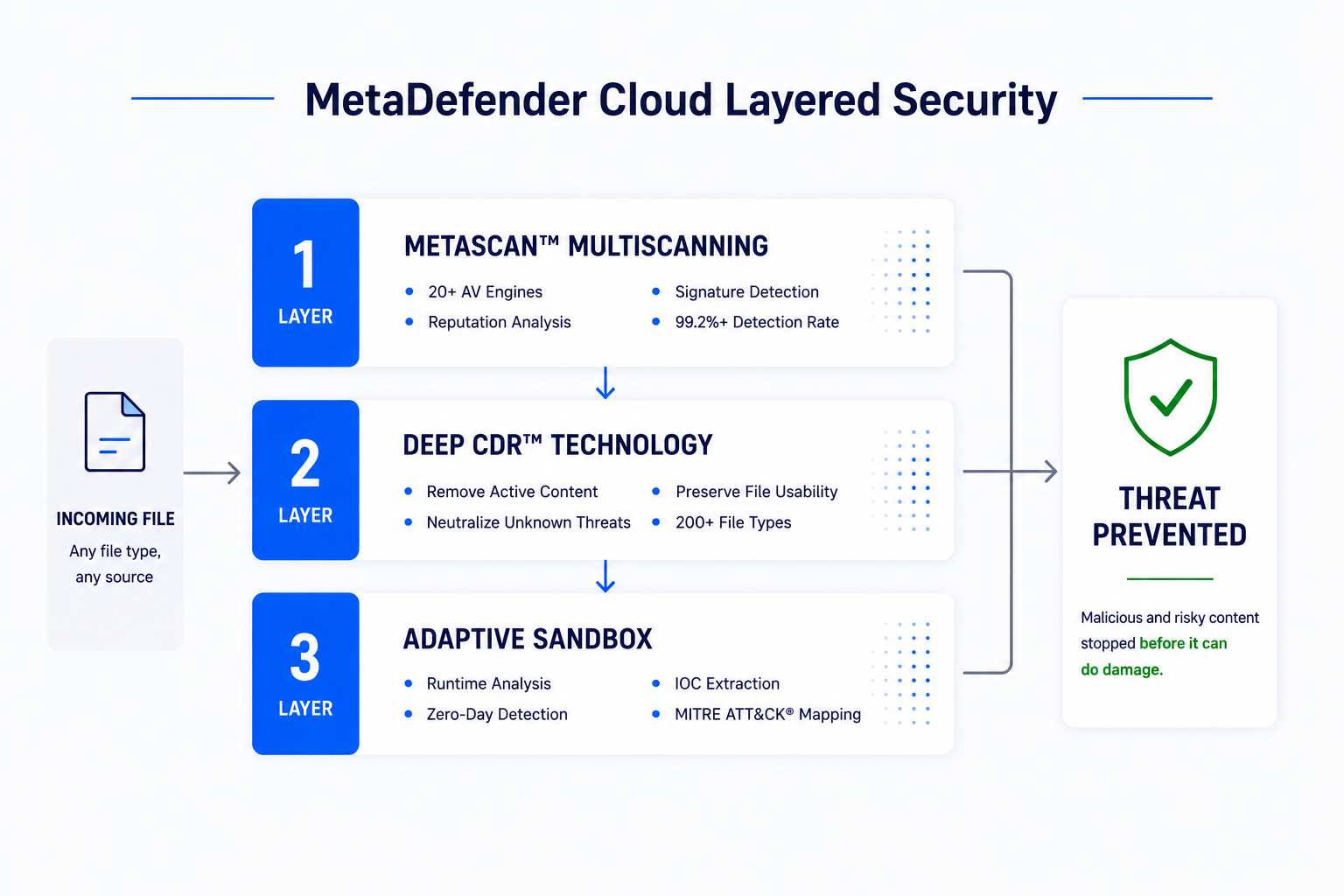
Performs high-speed malware scanning across 20+ anti-malware engines simultaneously, increasing coverage and reducing the risk of single-engine blind spots. Detection rates can reach +99.2%.
Neutralizes threats by deconstructing and rebuilding files and removing active content while preserving usability. Deep CDR supports 200+ file types.
Uses emulation-based dynamic analysis to inspect advanced threats. Additionally, it extracts actionable IOCs and supports SOC, threat intelligence, MITRE ATT&CK mapping, and hunting workflows at scale.
MetaDefender Cloud is available free of charge for security-conscious users who want fast, on-demand threat analysis. With no account required, anyone can instantly scan files, URLs, IPs, or hashes using enterprise-grade technologies including multiscanning, Deep CDR, and dynamic sandbox analysis. Clear verdicts are delivered in seconds.
For organizations with higher-volume scanning needs, paid plans offer more scalability, availability, and faster processing speeds. Enterprise teams can deploy the same powerful detection pipeline at scale through API-driven integration and rich IOCs for SIEM/SOAR integrations.
Combining Static and Dynamic Analysis for Modern Threat Defense
Modern malware is becoming more adaptive, evasive, and difficult to classify, but the detection gap is not an impossible problem.
The good news is that, as threats evolve, defensive technologies evolve alongside them.
MetaDefender Cloud brings together multiscanning, Deep CDR, adaptive sandboxing, threat intelligence, and behavioral analysis into a single platform designed to help organizations detect known threats, neutralize unknown ones, and investigate what remains.
You can test the platform for free and experience the full layered detection pipeline firsthand; no account required.
Frequently Asked Questions
What is the difference between static and dynamic malware analysis?
Static analysis examines a file without executing it, looking at file characteristics like hashes or signatures, Dynamic analysis detonates a file in a controlled environment, looking at behavior rather than attributes.
Can static analysis detect zero-day malware?
No; static analysis needs malware signature to function. By definition, zero-days don’t carry signatures.
Why do organizations use both static and dynamic analysis?
Neither method provides complete coverage on its own. Organization use static analysis for speed and scalability, while dynamic analysis is used for its depth, when more sophisticated malware appears.
How do attackers evade sandbox detection?
Sandbox detection can be avoided with environmental awareness - malware can detect a sandbox and it lays dormant, time-based evasion - artificial delays meant to outlast the duration of the analysis, an even user interaction checks - used by advanced malware strains, who wait for natural user behavior to execute.
Can malware bypass antivirus and sandbox detection?
Yes. Attackers can evade AV detection via code obfuscation - hiding its signature from static analysis - or via fillers attacks; evading AVs altogether. Sandboxing is evaded when the malware is aware of its environment, so it lays dormant or when it uses time-based evasion -artificial delays used to outlast the duration of automated sandbox analysis.
When should you use static analysis vs. dynamic analysis?
Static analysis can be used for triage, as a first layer of defense, especially if you're handling high file volumes on a daily basis. Dynamic analysis should be used when threats cannot be confidently detected or safely removed.
How does MetaDefender Cloud help close the malware detection gap?
MetaDefender Cloud approaches file handling from a multi-layered perspective: multiscanning inspects files with 20+ anti-malware engines, Deep CDR removes active content from productivity files, and adaptive sandboxing detects evasive malware.