
Key Takeaways
FakeAgent used sponsored Bing results and a user-generated Claude Artifact to distribute a fake Claude Desktop installer to at least 29 organizations.
The attack abused two legitimate signed executables to sideload malicious DLLs, then used VMProtect, GPU-based sandbox checks, and BNB Smart Chain configuration to complicate analysis and infrastructure disruption.
Defenders should scan every component of an installer bundle and correlate reputation results with file metadata, module loads, persistence, and network behavior. A valid signature on the executable does not establish that adjacent DLLs are safe.
Huntress observed a malvertising campaign on July 21–22, 2026 that compromised at least 29 organizations and delivered SectopRAT through a fake Claude Desktop installer. The campaign combined a sponsored Bing result, a user-generated Claude Artifact on the legitimate claude.ai domain, two DLL sideloading chains, and BNB Smart Chain contracts used to resolve downstream infrastructure.
Huntress tracks the activity as FakeAgent. Its findings show that familiar trust signals, including a legitimate domain and valid code-signing certificates, did not establish that the advertised software or the DLLs loaded at runtime were trustworthy. The observed payload could steal browser data, credentials, payment information, files, and other sensitive data, and it included hidden virtual network computing functionality.
Search advertising drove victims to a credible-looking page; signed executables loaded malicious DLLs; VMProtect and GPU-based checks hindered analysis; and blockchain-hosted configuration helped the operators rotate infrastructure. Huntress attributed the final payload to SectopRAT or a closely related fork; treat family attribution as an analytical assessment rather than a definitive operator identity.
How the Fake Claude Desktop Attack Works
A sponsored Bing result directed users to a public Claude Artifact on claude.ai. The Artifact redirected them to attacker-controlled domains that served ClaudeDesktop.exe, a renamed JetBrains jcef_helper.exe binary.
The signed JetBrains binary loaded a malicious libcef.dll from the same directory. A second signed binary, IBM SPSS sslconf.exe, later loaded tempdir.dll, which performed GPU-based environment checks and decrypted the embedded SectopRAT payload.
The malware used BNB Smart Chain contracts to retrieve encrypted configuration and resolve downstream command-and-control infrastructure. This allowed the operators to change infrastructure without rebuilding the loader.
From a Search Result to a Malicious Claude Download
The infection started with an ordinary search for the Claude Desktop application. According to Huntress, malicious sponsored results appeared in Bing searches for terms related to Claude Desktop. One advertisement was especially convincing because it led to a public Claude Artifact hosted on the legitimate claude.ai domain.
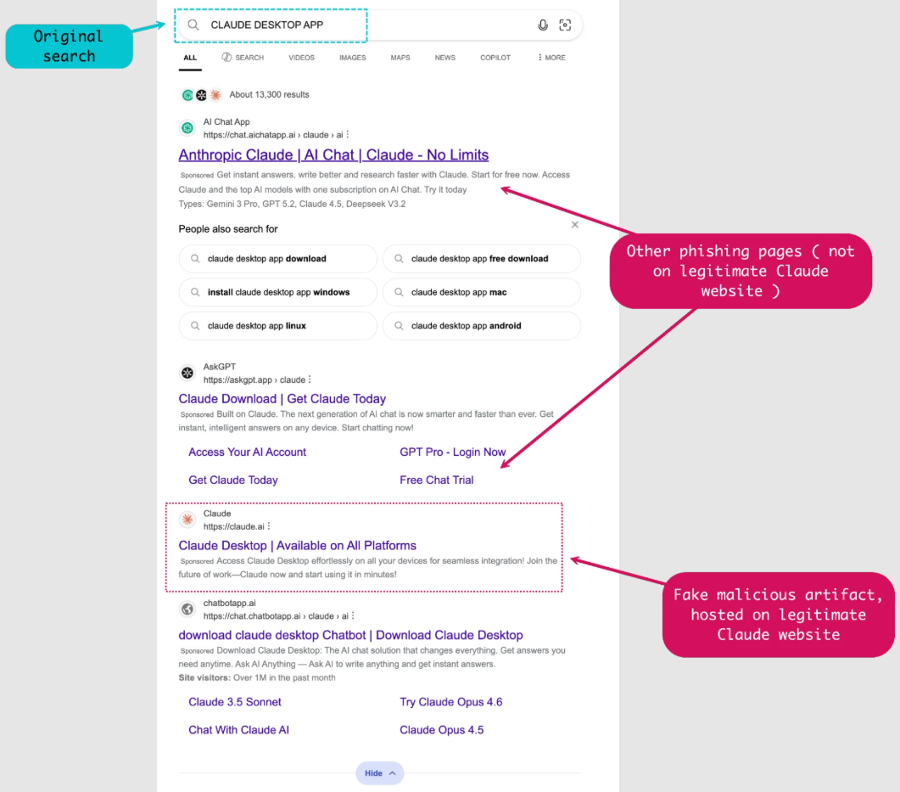
Source: Huntress article
The Artifact was user-generated, not an official Anthropic download page. Its location on a recognizable domain increased its credibility even though Claude displayed a notice that the content was unverified. Huntress reported approximately 7,100 views before Anthropic removed the Artifact.
Clicking its download button did not retrieve Claude directly. Instead, victims were redirected through attacker-controlled infrastructure:
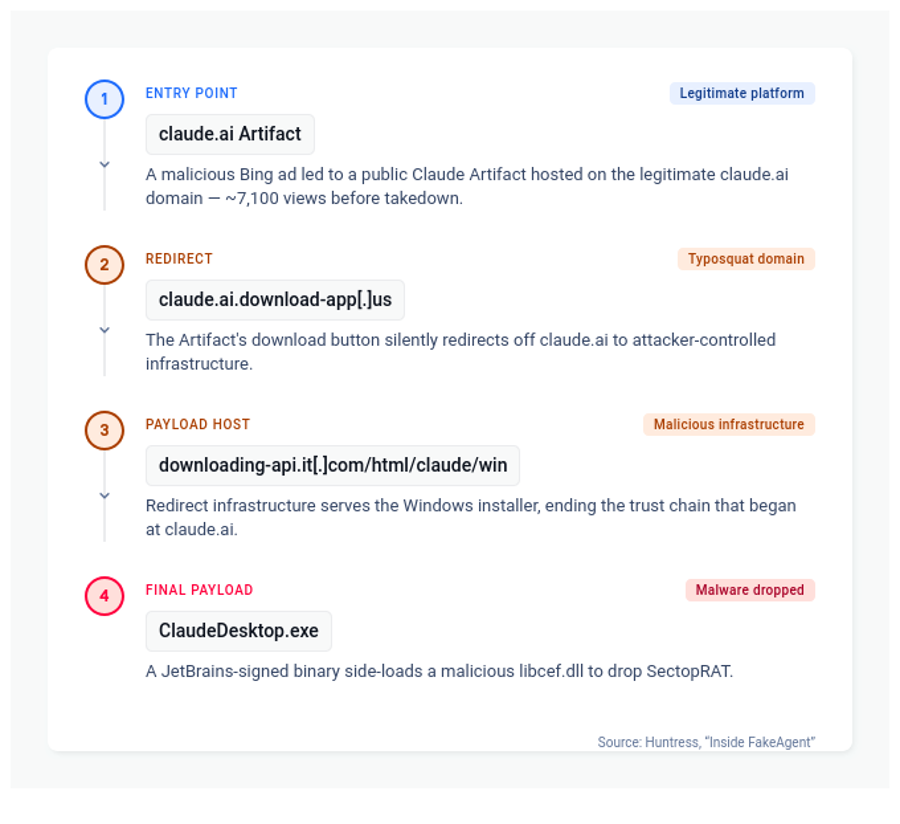
ClaudeDesktop.exe Is Not What Its Name Suggests
FakeAgent presented the executable as ClaudeDesktop.exe. Despite the filename, Huntress found that the executable was actually a legitimate JetBrains jcef_helper.exe component, based on Chromium Embedded Framework.
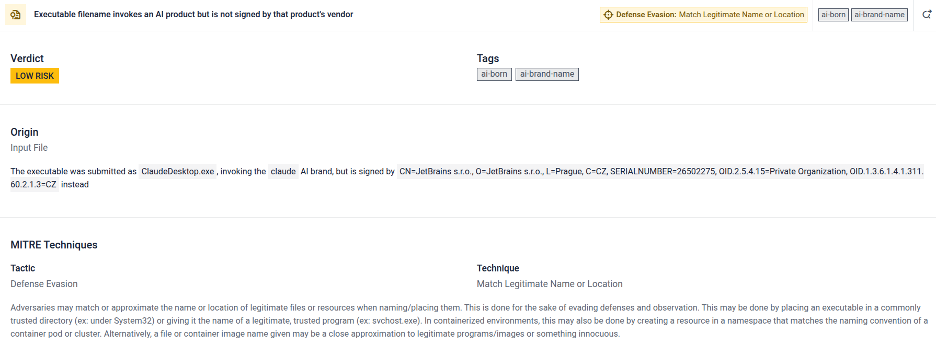
Although the filename invokes the Claude brand, the executable is digitally signed by JetBrains. Filescan, OPSWAT's next-gen malware analysis platform and adaptive threat-scanning service, identifies that the Claude AI brand was used in the file name as a lure. The same binary was also deployed as DockerDesktop.exe elsewhere in the infection chain.
The signed executable itself was not malicious. Instead, the attackers abused it for DLL sideloading, taking advantage of how applications locate and load dependent libraries. By placing a malicious DLL with an expected filename in a location searched by a legitimate application, attackers can cause the trusted program to load and execute their code.
In this campaign, a tampered libcef.dll was placed beside the JetBrains executable. Execution of the renamed jcef_helper.exe caused the signed process to load the malicious DLL. This arrangement can complicate triage because the parent executable retains a valid signature even though the loaded library is malicious.
DLL Sideloading Leads to the Malware Stager
Huntress found that the malicious libcef.dll was protected with VMProtect, a commercial software protector that increases the time and resources required for static analysis and reverse engineering.
Researchers also identified references to a smart contract on BNB Smart Chain (BSC) inside this stage:
0xc1907d7be91f95903ad66d775c397302e7dd9228
Rather than relying solely on a conventional hardcoded command-and-control server, the malware used blockchain-hosted information to resolve infrastructure required by subsequent stages. This technique is commonly referred to as EtherHiding.
The design gives operators a durable configuration channel. Defenders can block a known downstream domain or server, but removing or changing a deployed public-chain contract is more difficult. An operator who controls the contract can update stored values and rotate downstream infrastructure without rebuilding the malware that reads them.
A Second DLL Sideloading Chain
Huntress identified a second signed executable used in the infection chain at:
%APPDATA%\Roaming\Microsoft\EdgeUpdate\Install\sslconf.exe
Once again, the executable itself was legitimate and digitally signed, this time belonging to IBM SPSS.
The accompanying tempdir.dll contained the malicious code and was loaded by the signed IBM executable. Unlike the VMProtect-packed first-stage DLL, this component used GPU-related anti-analysis and payload-decryption techniques.
Using the GPU to Detect Sandboxes and Hide the Payload
tempdir.dll queried graphics adapters for identifiers associated with VMware and QEMU, checked for less than 1 GB of video memory, and ran a compute-shader timing test. These checks were intended to identify virtual machines, sandboxes, or emulated execution environments before the payload ran.
An encrypted payload stored as appcfg.dat was processed using a DirectX shader rather than a conventional CPU-based decryption routine. This creates an additional analysis challenge because traditional reverse-engineering workflows are primarily designed around CPU instructions and common cryptographic implementations.
During its investigation, Huntress built an SM5 shader interpreter and determined that the routine implemented a modified form of AES-256-CTR, including a non-standard MixColumns operation. This eventually allowed the researchers to recover the contents of appcfg.dat.
Moving cryptographic operations into GPU shader code is an unusual way to make automated and manual analysis more difficult, particularly for tooling focused primarily on normal CPU execution.
The Final Payload: SectopRAT
Decrypting appcfg.dat exposed both a PE file and an obfuscated .NET assembly. Strings and functionality inside the .NET component referenced browser logins, cookies, autofill information, credit card data, FTP credentials, Discord, messaging applications, and other sensitive information.
Huntress assessed the payload as SectopRAT or a closely related fork of the family based on exposed strings, targeted data, observed behavior, hidden virtual network computing functionality, and related command-and-control services. The available evidence supports malware-family attribution, not attribution to a named operator.
The researchers also found another blockchain-based configuration mechanism inside the .NET payload. After recovering and decrypting its configuration, Huntress identified the campaign's active C2 address at the time of investigation:
2.24.131[.]246
The associated BSC contract was:
0xe012d0f34cde9b870e9d9ed566ea5f8fd9b92228
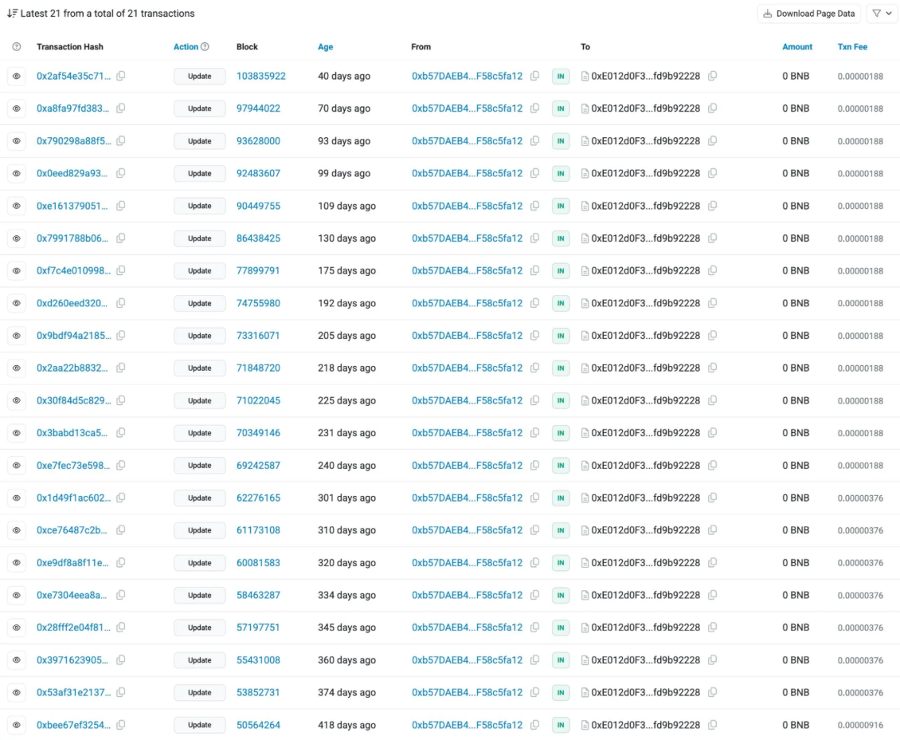
Source: Huntress
Filescan had previously identified this contract while studying a separate RedLine/META EtherHiding cluster. That research found 122 other BNB Smart Chain contracts with the same resolver bytecode template, but the recovered key did not decrypt traffic from the other contracts. The shared template indicates reuse of an implementation; it does not establish that the campaigns shared an operator or encryption key.
For additional analysis of this infrastructure, see EtherHiding Under the Hood: On-Chain Forensics Beyond the Public Disclosure.
Assessment and Defender Priorities
FakeAgent demonstrates how multiple individually legitimate technologies can be combined into a convincing and difficult-to-analyze infection chain.
The most durable detection opportunities are behavioral: a newly downloaded, renamed signed binary loading an unexpected DLL from the same directory; execution from user-writable paths; creation of a scheduled task for DockerDesktop.exe; Microsoft Defender exclusion changes; GPU-based environment checks; and outbound requests that lead from blockchain-resolved configuration to newly observed infrastructure.
For defenders, that makes contextual analysis particularly important. A file named ClaudeDesktop.exe should not automatically be trusted because it is signed, just as content hosted on a legitimate domain should not automatically be assumed to provide legitimate software.
The broader lesson also extends beyond Claude. As AI products attract increasing search traffic and user interest, recognizable AI brands provide attackers with useful lures for malicious advertisements, fake installers, extensions, and download pages.
Organizations should therefore validate both the provenance of software installers and the components they load at runtime, particularly when software has been obtained through advertisements or unofficial download paths.
Recommended Detection Logic
Alert when jcef_helper.exe or sslconf.exe runs from a user-writable or unexpected directory and loads libcef.dll or tempdir.dll from the same location.
Correlate renamed signed binaries with low-prevalence adjacent DLLs, scheduled-task creation, Defender exclusion changes, and subsequent network activity.
Hunt for the published malicious DLL and payload hashes. Treat the JetBrains and IBM executable hashes as contextual indicators because the underlying files are legitimate.
Retain the blockchain contract addresses for enrichment and pivoting, but prioritize the resolved infrastructure and endpoint behavior; contract use alone is not necessarily malicious.
What It Means for Everyday Users
In simpler terms, attackers paid for a Bing ad that looked like a legitimate search result, sent people to a page on a real, trusted website, and handed them a fake Claude Desktop installer that could steal saved passwords, browser logins, and payment card details.
How to Protect Yourself
Don't download software from ads.
Type the company's address into your browser (for Claude, that's Anthropic's own site) or use a bookmark you made earlier. Don't get there through a search result.
A legitimate domain alone is not enough to establish trust. If you are unsure about an installer, verify its source and scan the file with MetaDefender Cloud before executing it.
Be extra careful with popular AI tools; attackers go where the attention is, and right now that revolves around AI apps.
Limit what can be stolen; use a password manager instead of saving logins in your browser, and turn on two-factor authentication or passkeys for your bank and email.
Tl;dr: If the installer came from an ad, close the tab and go to the official site yourself.
MetaDefender Cloud Perspective
The FakeAgent campaign illustrates why an installer should be treated as a package of related files rather than as a single signed executable.
In MetaDefender Cloud, analysts can submit the downloaded executable, adjacent DLLs, and extracted payloads separately for multiscanning, file-type verification, metadata analysis, and reputation checks.
The highest-value workflow is component comparison. The JetBrains and IBM executable hashes may return as known benign files, while libcef.dll, tempdir.dll, or the embedded payload may produce malicious or suspicious results. Analysts should compare the executable's original filename, signer, expected path, and loaded modules instead of treating a valid signature as a clean verdict.
MetaDefender Cloud reputation services can enrich file hashes, IP addresses, URLs, and domains, while its REST API can automate lookups and send results to security workflows or a SIEM. For FakeAgent, this supports rapid triage of the published indicators and later pivots when downstream infrastructure changes.
Sandbox analysis can add behavioral context and extract indicators, but FakeAgent's GPU and virtual-machine checks show why detonation results should not be used alone. A sample that does not execute in a sandbox is not necessarily benign; combine sandbox output with multiscanning, static metadata, reputation, and endpoint telemetry.
Go to metadefender.com and explore MetaDefender Cloud's file scanning, threat intel, and sandbox capabilities for free; no account required.
Indicators of Compromise
The following primary indicators were published by Huntress as part of its FakeAgent investigation. Because attacker infrastructure can change over time, network indicators should be combined with file hashes and behavioral detections rather than treated as standalone evidence.
| Type | Indicator | Description |
|---|---|---|
| URL | claude[.]ai/public/artifacts/ca456f1f-44c0-42af-b329-4f1c7534a877 | Malicious Claude Desktop download page |
| Domain | download-app[.]us | ClaudeDesktop.exe redirect infrastructure |
| Domain | 5ca8758c-02d0-4a72-89c8-d468b66dda41[.]com | Backup SectopRAT domain |
| IPv4 | 2.24.131[.]246 | SectopRAT C2 observed by Huntress |
| BSC contract | 0xe012d0f34cde9b870e9d9ed566ea5f8fd9b92228 | SectopRAT blockchain configuration |
| BSC contract | 0xc1907d7be91f95903ad66d775c397302e7dd9228 | libcef.dll stager blockchain configuration |
| SHA-256 | 1cd58cfba596da296ab1878d74023e00c399345a1b6c2a0e5446c53563f4e3bb | Malicious tempdir.dll |
| SHA-256 | 26bae4d7012bf59847ab4036a065419c3d4ca47e020479f55b3b2c6d0d21394a | Malicious libcef.dll |
| SHA-256 | 1fe3646d27d286db8123297e06ae7badf3e26f352a04f91b6d82c28869a91664 | Embedded SectopRAT payload |
| SHA-256 | f8acb8f5cf88b77a4c27d7fd6856aa299bb178e85f9963c2fbd447d818da3ed0 | Benign JetBrains binary used as ClaudeDesktop.exe / DockerDesktop.exe |
| SHA-256 | fd826215add30c1319eefa291b6eaf8ddfa7720cfe816c49aef6fe8a88de7939 | Benign IBM sslconf.exe used for DLL sideloading |
Frequently Asked Questions
What is FakeAgent?
FakeAgent is Huntress's name for the July 2026 malvertising campaign that impersonated Claude Desktop and delivered SectopRAT through a multi-stage DLL sideloading chain.
Is ClaudeDesktop.exe malicious?
The file named ClaudeDesktop.exe was a renamed, legitimately signed JetBrains binary. The malicious behavior came from the tampered libcef.dll placed beside it and from later payload stages. The executable hash is therefore a contextual indicator, not a standalone malicious verdict.
Can file reputation alone detect FakeAgent?
No. Reputation can quickly identify known files and infrastructure, but this campaign mixed benign signed binaries with malicious DLLs and rotating configuration. Effective triage requires component-level scanning, metadata and signer validation, behavioral analysis, and endpoint context.
How can MetaDefender Cloud help investigate the campaign?
Analysts can use MetaDefender Cloud to scan each file with multiple anti-malware engines, inspect file metadata, check file and network-indicator reputation, and automate enrichment through the REST API. Sandbox findings should be interpreted alongside static and endpoint evidence because the malware includes anti-analysis checks.