
Defence Against AI Threats
How to Identify, Analyze, and Reduce Risks
AI is part of nearly every conversation; as the technology becomes more accessible, it’s only natural that the topic of AI-powered cyber threats is seen as an urgent concern. Yet the debate around their real impact continues to grow, with no clear signs of slowing down.
Some argue that the idea of AI-driven threats is simply a way to grab attention and raise awareness of cybersecurity challenges, which should already be taken more seriously. Others warn about deepfake cyber-attacks and polymorphic malware, genuine threats lurking in our systems, capable of disguising themselves so effectively that not even AI-based malware detection can identify them.
With that in mind, we explored threat intelligence databases, cybersecurity forums and communities, and drew on our own insights to find the most accurate answer possible: how close are we to Skynet?
How Are AI-Driven Threats Exploiting Systems?
One clarification, before we see how AI is used in cyberattacks: “AI-driven malware” does not refer to malware created entirely by AI. In practice, it is more of a spectrum.
At one end, AI is used as an assistive tool, helping attackers write code faster, deliver AI-obfuscated malware, or generate evasion techniques. At the other end, more advanced samples integrate AI directly into the malware itself. In these cases, the malicious program can dynamically generate code, adapt its behavior, or make decisions during execution based on predefined prompts.
The distinction matters.
Today’s “AI-driven malware” is human-directed, AI-enhanced, and increasingly adaptive. The fight isn’t against sentient computers, but against highly motivated individuals who have incredibly powerful tools at their disposal to amplify their speed and ability to evade detection.
In that sense, it’s still a human fight, with defenders standing a fighting chance.
AI-Driven Malware Adaptation
Looking at 2025 findings from threat intelligence and research groups, we see early examples of AI-driven malware that offer a glimpse into how these threats might evolve. Most of these cases involve malware that uses AI while running, allowing it to decide its next move and adapt its behavior in real time.
Variants such as Fruitshell[1] establish remote access to compromised systems.
Fruitshell can enable the execution of arbitrary commands while attempting to evade detection, including from LLM-assisted security tools.
More experimental strains are pushing the concept further.
PromptLock, discovered by ESET in August 2025, can carry out prompt injection attacks: LLMs generate and execute malicious scripts compatible across Windows, Linux, and macOS.[2]
It has demonstrated capabilities such as data extraction, file encryption, and filesystem reconnaissance. Notably, this is not simply malware written with the help of AI; it operates through sequences of prompts generated directly on the infected system.
Other examples include PromptSteal, which uses LLM APIs to generate one-line Windows commands. These commands are used to collect system information and documents in specific folders.
Then we have QuietVault, a credential stealer that aggregates data and uploads it to publicly accessible repositories, using AI to identify additional high-value information on infected machines.[3]
CVE (Common Vulnerabilities and Exposure) Exploits
Receiving far less attention than AI-driven malware, we have CVE exploitation. AI is shortening the window between vulnerability disclosure and exploitation.
In practice, organizations prioritize CVEs based on attack complexity, exposure vectors, and system criticality. Some vulnerabilities will remain unpatched for months, often with no immediate impact or viable exploitation path.
With AI, though, the weaponization of exploits, once measured in weeks, often around days, can be reduced to hours. In this case, the threat posed by AI is its role in accelerating both exploit development and the ability to operationalize attacks at scale.
In 2025, 60% of breaches[4] involving exploitation relied on vulnerabilities for which patches had already been available for more than 30 days. The situation is unlikely to improve.
From a pragmatic standpoint, this places defenders and attackers on unequal footing in a significant share of real-world scenarios.
How Are AI-Driven Threats Exploiting People?
In early 2024, an employee of UK engineering firm Arup made a routine money transfer following a video call with senior management.
Except there was no management call; the employee was tricked into initiating a $25 million transfer to criminals, based on deepfakes created with AI[5]. It’s but one example of generative AI cybersecurity risks. This one caught the news. Others don’t; so, the scale is hard to determine.
More than helping attackers create convincing deepfakes, AI is also making “traditional” scams far more effective. While these types of fraud existed long before AI, the technology makes them more believable and more convincing at scale.
The sheer volume of AI-driven phishing attacks and other scams is rising as well: Based on CBC News, the monthly average increased from 2.14 billion calls in 2024 to 2.56 billion in 2025 [6].
With AI assistance, either for deepfake generation or brute force scalability, generating deepfake scams that feel more real, more convincing, and harder to resist.
There are cases where even AI-powered chatbots are falling for phishing.
Netcraft researchers asked GPT-4.1-based chatbots to surface login pages for 50 different brands across industries like finance, retail, tech, and utilities [7].
The bots got it right 66% of the time. But 5% of the domains returned belonged to unrelated yet legitimate businesses, and 29% were unregistered, parked, or had no active content at all.
In other words, 34% of all suggested domains were not brand-owned and potentially harmful. With the common habit of clicking before thinking, these are risks that simply can’t be ignored.
It was one thing when phishing meant grammatically challenged emails. Annoying, but easy to spot if you kept your wits about you. But now, attackers have voices, faces, and even deepfake videos to work with.
While caution is important, constantly questioning everything you see creates a sense of disorientation, which only leaves us more vulnerable in the long run.
With that said, can we fight the very real AI-driven threats we’re seeing?
How to Detect AI Malware Through a Prevention-First Mindset
The usual advice still applies: don’t download or execute files if you don’t trust the source. Some rules are classics for a reason.
However, AI does complicate cybersecurity. If malware can dynamically rewrite its own code to optimize data exfiltration, it can also adapt to evade detection. Polymorphic malware has existed for years; AI simply accelerates and scales this capability.
Traditional security tools, particularly those relying on signature-based detection, fail at identifying such threats.
Security can’t stay reactive.
The best defense is a proactive one. Don’t gamble with an open-door policy; weld those doors shut and seal off opportunity before it even arises.
Use MetaDefender Cloud for True Resilience
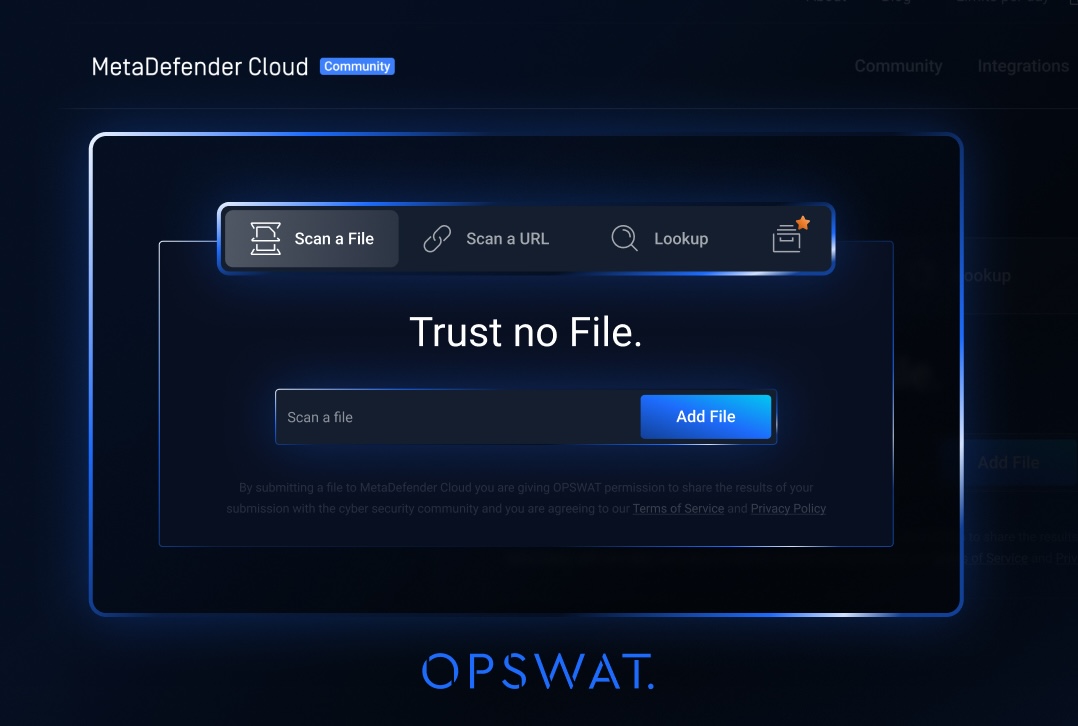
MetaDefender Cloud is a free file, URL, and hash malware analysis platform, capable of identifying malicious AI file uploads using multiscanning, Deep CDR, AI-Native Zero-Day Prediction, and AI Content Detection.
Removing any barriers, Community is a free-to-use, no-account-needed service built to bring together IT professionals, SOC teams, researchers, students, and everyone in between.
Multiscanning Technology
With detection rates of +99%, multiscanning uses 20+ anti-malware engines to scan/ check files, URLs, hashes, and IP addresses.
Instead of relying on a single engine’s verdict, it aggregates results from multiple engines to provide a broader and more reliable verdict. Since anti-malware solutions update their signature databases multiple times a day, multiscanning can act as a form of real-time AI threat detection, provided the malware is known.
URL lookup serves as effective self-protection; it’s a preventive tool against phishing attacks or deepfake threats.
Before clicking a link, you can verify its safety by checking it against multiple vendor databases. If the destination is flagged, it indicates potential risk (malware delivery or credential harvesting through spoofed pages) allowing you to avoid exposure to deepfake security risks.
Deep CDR Technology
Deep CDR technology is particularly useful for Zero-Day AI malware protection, as it does not rely on detection or verdicts. This approach works against AI malware in PDF and files and other forms of malicious AI file uploads, where traditional scanning methods may fall short.
It deconstructs files and removes all potentially dangerous elements (such as macros, embedded executables, or scripts) to prevent malicious content from reaching systems. It then reconstructs and delivers a safe, usable version of the file to the end user.
Deep CDR does not scan for or attempt to identify malware. Instead, it assumes that all incoming files may be malicious.
This makes it particularly resilient against AI malware embedded in PDFs and other files, as well as increasingly sophisticated malicious AI file uploads designed to evade detection. Any embedded threats are removed outright before they even have a chance to modify or obfuscate their code.
AI-Native Zero-Day Prediction and AI Content Detection
The Predictive Alin AI technology identifies malicious intent from intrinsic file characteristics. Using Machine Learning, this technology removes the need to rely on historical prevalence.
With traditional file scanning, threats must be discovered, analysed, and catalogued before broad protection can be updated. Predictive Alin removes the dependency, detecting polymorphic, repacked, and structurally modified malware.
Additionally, the AI-Generated Content Detection looks for patterns in text and images, as well as specific genAI signatures, to determine whether a file is generated by AI, or a human.
In a “fight fire with fire” approach, these two technologies should contribute to the general fight against AI-driven malware and deepfakes, threatening the online world today.
You can read more about technologies powering MetaDefender here.
How to Combine Human Judgment and Powerful Tools to Outthink AI
So, are we approaching a sci-fi scenario?
Not quite. But AI has changed cybersecurity, acting as a force multiplier for bad actors.
AI-assisted hackers and scammers are more capable than ever: they can write and modify code faster, craft more convincing scams, and exploit vulnerabilities before defenders have time to respond.
Yes, the tools may be more advanced and the malware more evasive. But there’s room for effective defence, as humans can still stay one step ahead.
The caveat is to remain vigilant, informed, and proactive.
As AI-driven threats become more adaptive, prevention remains one of the most effective ways to reduce risk.
With MetaDefender Cloud, you can quickly analyze files, URLs, and hashes, helping you verify content before it reaches your systems.
FAQ
What are the biggest AI cyber threats in 2026?
In 2026, the biggest AI threats come from threat actors reinforcing their efforts to write code faster, deliver AI-obfuscated malware, or generate evasion techniques. Additionally, deepfakes can lead to more believable and thus more successful phishing attacks.
Why is AI-powered phishing so hard to spot?
AI-powered phishing removes many of the classic warning signs people used to rely on, replacing them with highly tailored, convincing messages. With generative AI becoming more powerful, it’s easier to create fake texts, images, or videos, exploiting human trust and convincing them to act.
How do deepfake attacks actually work?
Deepfake attacks use AI to create highly realistic fake content that impersonates people, in order to deceive others into trusting and acting on false information.
Why doesn’t traditional antivirus catch AI malware?
AI malware signatures aren’t usually included in databases. Traditional antivirus engines can only detect malware if the malware’s signature exists inside a database. AI-driven malware can be unique for every infection or rewrite its code post-detection to obfuscate itself, reducing the effectiveness of signature-only approaches.
How fast can attackers exploit a vulnerability once it’s public?
Based on 2025 industry reports, roughly 50% to 61% of newly disclosed vulnerabilities saw exploit code weaponized within 48 hours.
What is Predictive Alin AI and why does it matter?
Predictive Alin AI predicts malicious intent by looking at file characteristics. The technology removes the need to rely on historical prevalence, predicting threats which might pass traditional detection.
How can I protect my organization from AI-powered cyber threats in 2026?
Effective protection requires a layered strategy that combines prevention, real-time detection, rapid response, and continuous adaptation. Multiscanning and Deep CDR technologies combined with AI-powered threat and content detection can provide the layered security which contributes to strong cyber resilience.
Sources