
It hasn’t been a very good April for Grafana’s security reputation.
After a file write vulnerability which could theoretically enable remote code execution (CVE-2026-27876) was found, researchers from Noma Security also discovered and disclosed the GrafanaGhost exploit.
At its core, GrafanaGhost is a prompt injection attack.
In practice, Grafana’s AI misinterprets hidden, keyword-triggered instructions as legitimate prompts, causing it to bypass its own guardrails. This enables the exfiltration of sensitive business data by avoiding client-side protections and allowing attackers to connect private data environments to external servers.
Fortunately, Noma’s researchers only broke the system for educational purposes and disclosed the vulnerability immediately. As of the moment of writing, there are no publicly disclosed data leaks originating from GrafanaGhost.
However, should a real breach have happened, it could have potentially enabled unauthorized access to sensitive operational data, private customer data, or telemetry.
What Are Common Risks Associated with Data Visualisation Platforms
The GrafanaGhost vulnerability is the natural outcome of Noma Security’s approach. Traditionally, threat actors would target the weaknesses typically associated with data visualization platforms:
Exposed dashboards: whether through negligence or malicious intent, dashboards containing financial, sensitive, or telemetry data may be left publicly accessible. In practice, this means that anyone who knows where to look can access the exposed information at any time.
Weak authentication: attackers may rely on account hijacking to obtain the credentials of users with dashboard access, allowing them to reach sensitive or proprietary information.
Misconfigurations: improperly configured or incomplete settings related to access controls, privacy, exports, and other permissions can create exploitable loopholes, ultimately leading to sensitive data exposure.
All three stem from human error.
GrafanaGhost, however (and likely many of the future vulnerabilities platforms similar to Grafana will face) became possible precisely because humans were removed from the loop. The vulnerability came from an implicit, assumed trust in automated systems which operate without meaningful oversight or verification.
Built Faster Than It Can Be Secured
You would think that, by now, enough AI-driven attacks have occurred for proper defensive strategies to have been developed.
But the issue is foundational. AI features are being stacked onto applications that were never designed to face AI-specific threats in the first place.
Attackers don’t bother as much with hunting for traditional vulnerabilities to exploit; they go straight for the AI tools and agents. AI systems evolve rapidly, creating ongoing challenges for long-term security, sometimes evolving faster than they can be secured with a permanent AI workflow security architecture.
It’s like trying to empty a river with a ladle.
That’s how you end up in situations where security layers are stacked on top of other security layers, each with its own exploitable weak points. Remove one weak piece, and the entire structure collapses.
Data Observability Is Not Data Security
In the case of GrafanaGhost, a prompt injection could be brute-forced into the agent’s behavior until the agent eventually allowed data extraction. But these systems can also be penetrated via malicious files; whether outright infected or containing hidden prompt injections.
In short, data from multiple sources enters Grafana without being inspected in any way. That data may be:
Unvalidated, leading to an AI agent treating malformed or spoofed input as legitimate. Consequently, the agent might deliver corrupted outputs, allow for unauthorized actions, or generate the accidental exposure of internal system behavior.
Sensitive, being exposed or redistributed by the AI to unauthorized users or systems.
Manipulated, creating opportunities for misinformation, false analytics, privilege abuse, or the gradual poisoning of operational workflows.
Malicious (embedded payloads or hidden prompt injections) weaponizing the AI system against itself.
Grafana is excellent at observability. But observability doesn’t equate to data security: verifying file health, detecting sensitive data where it shouldn’t be, and ensuring that processed files don’t lead to security or compliance risks.
And that’s where companies expose themselves to unnecessary risks.
These could be avoided through a granular policy focused more on inspecting the files and data processed by Grafana at the injection stage, rather than relying solely on perimeter security and the assumption that the files are safe.
The Consequences of Unvalidated Data
When data is assumed to be safe simply because it has entered the system, dashboards become a point of blind trust.
Users trust the files enough to export them, upload on storage systems, or share inside a connected network. Unknowingly, users handling unvalidated data will create the opportunity for data leakage, compliance issues, or misleading insights.
Uninspected or improperly validated inputs can expose sensitive information, violate compliance requirements, or distort analytics. The result is the operational and regulatory impact that may only become visible after bad decisions have already been made.
Where Traditional Security Falls Short
In a sense, file-based attacks are much alike the premise of every great heist film.
You can station armed guards at every entrance, monitor live camera feeds around the clock, and install motion sensors to detect suspicious activity.
But if the perpetrator is able to walk in and out in broad daylight without raising suspicion, simply because their presence is implicitly trusted, then all initial security measures become obsolete.
Traditional security models were designed to protect the perimeter: to stop unauthorized access, detect intrusions, and block suspicious external activity. They were never built to question the legitimacy of the data itself once it had entered the system.
As a result, files moving through internal pipelines are often treated as inherently trustworthy. Security controls may inspect where a file came from, who uploaded it, or whether it matches known malware signatures, but far less attention is given to the file’s actual behavior or hidden instructions once it reaches AI systems or automation tools.
In practice, this creates the equivalent of a seemingly trustworthy person walking freely through every checkpoint unchallenged: the defenses remain focused on the perimeter, while the threat travels freely on the inside.
Transition to Granular File-Level Inspection with MetaDefender Cloud
File-based attacks are only effective when files aren’t subjected to deep, multi-layered inspection.
MetaDefender Cloud flips the assumed trust on itself, by deploying multifaceted inspection points, rooted in Zero Trust principles.
No file is trusted; therefore, all files are scanned, sanitized, and observed before they enter systems.
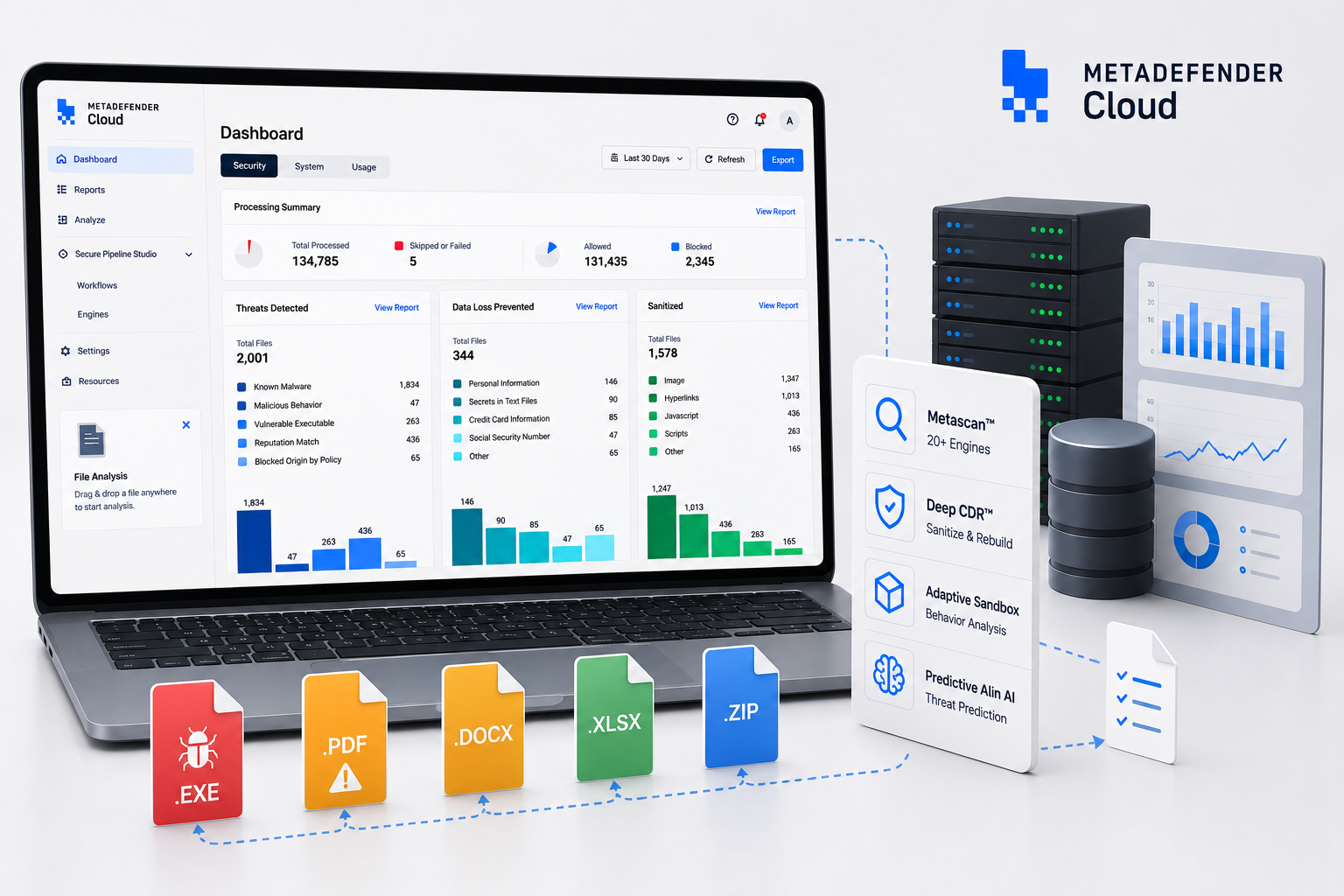
Inspect and Sanitize Data before it Enters Systems
Files handled by MetaDefender Cloud are both scanned and sanitized.
Sanitization is key because no antivirus can achieve a 100% detection rate, meaning it does not rely on detection alone. Instead, it deconstructs files and removes anything with the potential to cause harm.
Files entering data visualization platforms such as Grafana pass through multiple checkpoints, preventing users from accidentally uploading malware, ransomware, or files containing prompt injection attacks that could lead to data breaches.
Multiscanning, Deep CDR, and Sandboxing Capabilities
MetaDefender Cloud combines Metascan™ multiscanning with Deep CDR™ technology for in-depth file analysis. Files are scanned using 20+ anti-malware engines and then sanitized, potentially risky elements being removed. Additionally, MetaDefender Aether, OPSWAT’s sandboxing technology, detonates executables in a safe environment to observe their behavior.
Supports a Zero-Trust approach
Zero Trust is a cybersecurity framework based on the philosophy “never trust, always verify”, assuming any file can lead to a breach and continuously validating even trusted sources.
MetaDefender Cloud embodies this approach, through a three-step file handling process: files are scanned, sanitized, and observed. Threats that bypass scanning are eliminated through CDR or analyzed in a sandboxed environment.
Industry Best Practices
There are several layers of security which must be considered when addressing the data pipeline risks of 2026.
With or without specific tools, the effectiveness of an AI workflow security strategy is dictated by timeless principles and strategies that simply need to be adapted to current threats.
Validate All Incoming Data Sources
Since attackers disguise malicious content as legitimate, and AI agents aren’t equipped with the critical thinking needed to discern between safe and infected, establish clear policies for source validation.
All files, API responses, email attachments, or uploads should be verified before included onto platforms.
Apply Inspection at Ingestion Points
Since prompt injection happens at entry-point, security controls are most effective when inspection happens exactly at the point where data enters the environment. Scanning, sanitization, and behavioral analysis applied at ingestion points can stop malware, ransomware, and hidden payloads before they spread across systems.
Don’t assume trusted systems deliver trusted data
A trusted platform does not automatically process safe information, as malicious payload in data pipelines can still exist.
Many modern attacks use legitimate applications, cloud platforms, or third-party ecosystems to deliver malicious content, which is why all data should be continuously verified regardless of its source. In practice, this means file security policies applied each time a file is uploaded, downloaded, stored, or shared.
Eliminate “Ghosts” Through Data Integrity and Inspection Policies
AI doesn’t “understand” data in a critical thinking sense. Abandoning security principles in favor of blind trust is how hidden payloads, poisoned analytics, and prompt injections move through systems unnoticed.
Yes, platforms like Grafana deliver enormous operational value, but this isn’t an argument for eliminating extra steps required by secure file handling policies.
Data should be verified before it reaches dashboards, automation workflows, or AI agents. File-level inspection, sanitization, sandboxing, and behavioral analysis reduce the risk of malicious content spreading inside trusted environments.
MetaDefender Cloud supports this process through its layered technologies, strengthening the security pipeline and reducing exposure to modern file-based and AI-assisted attacks.
Still, effective cybersecurity depends on disciplined security practices, layered defenses, and the willingness to question assumptions.
Especially the assumption that trusted systems automatically process trusted data. With its “trust no file” philosophy, MetaDefender Cloud sits right at the heart of this approach.